Key takeaways: after a home blood test
- The laboratory measures, the clinician interprets: your results are reviewed by a UK-registered clinician, not just sent as a PDF.
- Abnormal does not always mean a condition: reference ranges are a guide, and some healthy people fall slightly outside them.
- One result rarely gives a diagnosis: your symptoms, history and sometimes further tests all matter.
- You are told when to see your GP: a home blood test does not replace your GP or NHS services.
- You can ask questions: a follow-up clinical call is available if you want to talk your results through.
What happens to your blood sample?
Once you have collected your sample at home and returned it, it is sent to a laboratory for analysis. Laboratory quality matters, because blood results are only useful if you can trust how the sample was analysed. PrivateDoc uses an accredited UK laboratory with established quality processes designed to support accurate and reliable results.
Different laboratories can use slightly different methods and reference ranges. This is why you should read a result against the reference range printed on your own report, rather than comparing it with a generic range found online. To read more about how laboratories and sampling methods differ, see our guide to home finger prick blood tests compared with venous tests.
Are home blood test results reviewed by a clinician?
Yes. At PrivateDoc, results are individually reviewed by UK-registered clinicians. A laboratory can tell us what has been measured, but interpreting a result is about understanding what the numbers may mean for the individual patient.
Your clinician reviews your results and gives a personalised explanation, highlighting findings that may need monitoring, further investigation or discussion with your GP. Sometimes the most important part of a result is not whether a number is labelled "normal" or "abnormal". It is understanding it in the context of your health, symptoms and the reason you tested.
What does an abnormal blood test result mean?
Seeing a result marked high, low or outside the reference range can be worrying. But an abnormal result does not automatically mean you have a medical condition. Reference ranges help clinicians interpret results, but they are not absolute dividing lines between healthy and unhealthy. NHS laboratory guidance notes that around 5% of healthy people have results marginally outside a quoted reference range.
Results can also be affected by:
- your age
- medicines or supplements
- recent illness
- whether you had eaten or fasted
- the time the sample was taken
- pregnancy
- existing medical conditions
- how the sample was collected or transported
This is why a single result should not usually be interpreted without the wider picture.
A simple example: when the blood result is not the whole answer
Imagine Sarah, aged 30. She has irregular periods and some other symptoms that make her wonder whether she could have polycystic ovary syndrome (PCOS), so she has a home blood test to learn more about her hormone levels. Some of her results come back borderline. Alongside her symptoms, they could support a diagnosis of PCOS, but the blood results alone cannot confirm it.
This is where clinical interpretation helps. Rather than just telling Sarah that some results are outside the expected range, a clinician can explain what they might mean and why a diagnosis cannot be made from a single blood test. PCOS is diagnosed by looking at the whole picture: menstrual history and symptoms, evidence of raised androgen activity from symptoms or blood tests and, where appropriate, an ultrasound of the ovaries. An ultrasound is not needed in every case, and other causes of similar symptoms may need to be ruled out.
Sarah could then be given practical guidance on what to discuss with her GP, such as:
- how often she has periods and whether they have become irregular
- symptoms such as increased facial or body hair
- persistent acne
- thinning of scalp hair
- changes in weight or difficulty managing weight
- whether further blood tests or assessment may be appropriate
- whether an ultrasound would add useful information in her circumstances
The test would not give Sarah a diagnosis of PCOS. It would give her useful information, clinical context and a clearer idea of what to do next. Sarah is a fictional example created to illustrate how results might be interpreted. She does not represent an individual PrivateDoc patient.
What happens if one of my results is outside the normal range?
The right next step depends on the test, how far the result is outside the expected range and the wider picture. Depending on the result, a clinician may:
- take no immediate action, if a small variation is unlikely to be significant
- suggest repeating the blood test after a suitable interval
- suggest lifestyle changes, where relevant to the result
- arrange a clinical discussion to look at the finding in more detail
- advise you to speak to your GP if further investigation, diagnosis, treatment or monitoring may be needed
- advise more urgent medical assessment if the result or your symptoms suggest it is needed
The British Heart Foundation similarly explains that an automatically flagged abnormal result does not necessarily mean something is wrong. Some abnormalities need no further investigation, while others need follow-up or treatment.
Will I be told if I should see my GP?
Yes. If our clinical review suggests GP follow-up would be appropriate, we explain why and give you specific advice about what you may wish to raise. A private home blood test is not meant to replace your GP or other NHS services when further examination, diagnostic tests, treatment or ongoing monitoring is needed. The aim is to help you arrive at that conversation better informed.
If you have urgent symptoms such as chest pain, severe shortness of breath or fainting, do not wait for a result. Contact NHS 111, your GP or emergency services.
Can I speak to someone about my results?
Sometimes a written explanation tells you everything you need. At other times you may still have questions. PrivateDoc patients can arrange a follow-up clinical call to talk through their results. This can help if you want to understand why a marker has changed, what your next steps might be, or why we have recommended speaking to your GP.
Where can I see my blood test results?
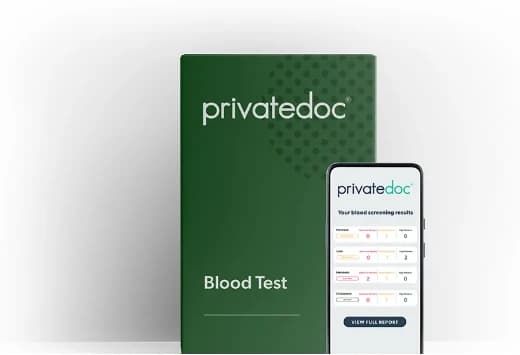
The PrivateDoc process is electronic. Your results and the clinician's explanation are available through your account, which gives you a digital record to return to when needed. The NHS does something similar, letting patients view eligible test results in the NHS App once they are added to their GP record. The important part, though, is not just making results visible. It is making them understandable.
Why clinician interpretation matters with home blood tests
The convenience of testing at home should not mean losing the clinical part of healthcare. A result slightly outside a reference range may turn out not to matter, another may need repeating, and, as Sarah's example shows, a result can be one useful piece of information without being enough to diagnose anything on its own. We explain this in more detail in why clinician reviews matter for home blood tests.
Our approach combines home sample collection, testing through an accredited UK laboratory, review by UK-registered clinicians, a personalised explanation, clear advice on when to speak to your GP, the option of a clinical follow-up call and electronic access through your account. The aim is not to give you more health data. It is to help you understand what it means and what to do with it.
Choose the test that is right for you
If you are unsure what your results mean, you can ask for a clinical call. Ready to test? Answer a few questions and we will match a kit. A clinician reviews the report in your PrivateDoc account.